by worker-correspondent Emily Jane Dennis
2025 feels a lot like 2017. Every day there is a new proclamation taking steps backwards, defying reality, dehumanizing people, and creating uncertainty. Each of these emerging issues and each person affected by them deserves time, effort, and care. Yet, individually, we can only do so much each day. Almost every single thing feels urgent, yet we must continue to care for ourselves and our immediate communities… add inflation, rocketing food prices, and rent gouging and it is easy to see that it takes more labor now to survive than it did even just a few years ago. As organizers, it’s easy to apply this logic to everyone but ourselves, and most of us have been through multiple burnout cycles… but it is a cycle we can break!
Towards this goal, I’m writing this “cheat sheet” as a love letter to my fellow organizers, activists, and caregivers who work towards a better and more just society. I hope this cheat sheet and zine helps other organizers invest their energy effectively as we all fight for a better world, together.
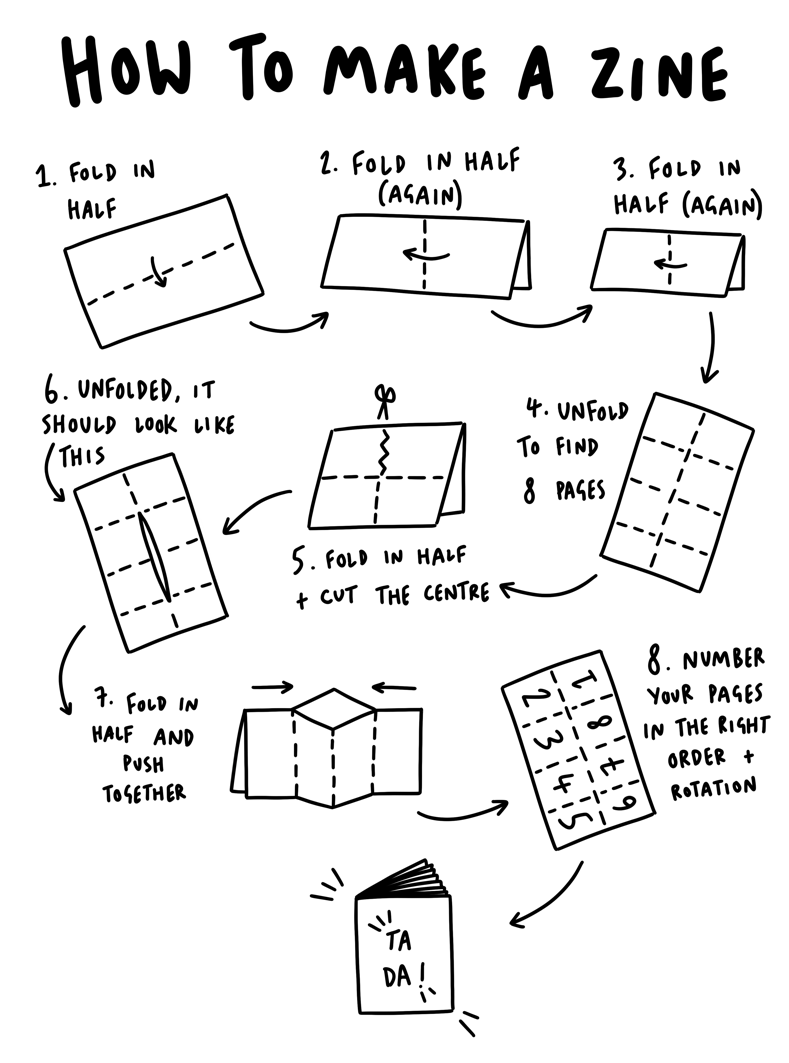
Please feel free to download, print, or distribute the zine below. Print “landscape” on an 8.5×11″ sheet of paper with uniform or no margins. See here or the bottom of the post for folding instructions.
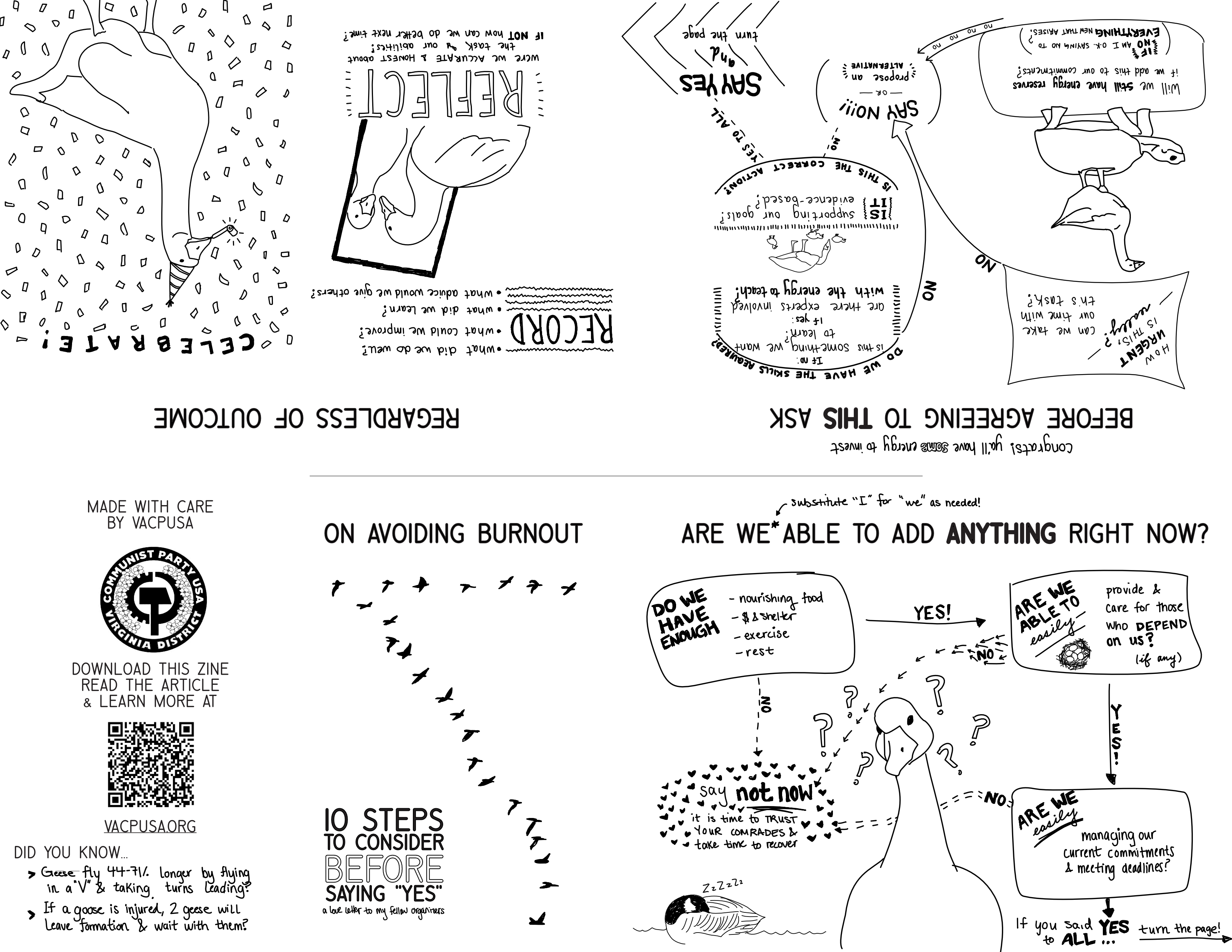

Before saying “yes” or engaging in a new struggle:
Can we take on anything extra right now?:
- Am I able to do the labor that financially sustains me, feed myself, exercise, and get the rest my body needs to continue this struggle for years to come?
- Do I have people who depend on me for their basic needs? Am I currently able to consistently meet their needs?
- Am I already committed to other activist work? If so, am I easily meeting deadlines for the ongoing struggles and work I have already committed to?
If you’re struggling with these things, it’s time to trust your comrades and say no for now. Cheer others on, recommend the action to another group or to up-and-coming folks within your organization, or just take the time you need to return to the struggle at a later date.
If you said yes to ALL of the above, before beginning a new task, consider if this is the correct action to take at this moment:
- Triage your time investment: Is the level of urgency accurate? What are the consequences if we do not do this now?
Often, organizers get URGENT ACTION NEEDED requests for things that can wait weeks or months with no downside. Even if we choose to respond immediately, knowing it can take weeks brings a different level of stress than knowing it must be finished today. If we give ourselves time to complete non-urgent tasks, it saves our energy for truly urgent actions when we are needed. - Do we have the skills required?: If not, is it a skill I want to learn and are the correct people involved to guide me as I learn that skill?
If not, say no. If you want to learn the skill, ask first if this is a situation where the skilled folks have the time and energy to help you learn these skills. Most organizers are agile and like learning new things, but playing to your strengths allows others to shine, get experience, and builds the group’s resiliency for those times when you may not be able to pitch in. - Do your homework: Is this action best suited for our desired goals? Has the proposed action ever been tried, and has that resulted in success?
If not, say no or propose an evidence-based action or something that has not been tried before. Often, people want to do something… but a task without a goal cannot succeed, and distracts from purposeful work. Even an identical action can be distracting for one group and useful to another. For example, if gathering signatures for a petition, while no amount of signatures will stop a foreign country from a harmful action against another foreign country, they’re incredibly useful for gauging community interest, delivering signatures to a local elected official, or educating people on an issue. - Triage your time commitments: if I say yes, will I still have some remaining time and energy? If no, am I okay with saying no to all new things, including those that may feel urgent? If you are willing to give up your remaining time for this task, tell your co-organizers first. Often, someone else will step up so you can remain agile and able to respond to the next crisis. If not, go for it, but be disciplined when the next request comes around: say no until you have more time, space, and rest.
If you answered no to any of these questions: say “no”, “not this”, or “not now”. It is okay to say “not now” to false urgency, “not now” to tasks that drain our remaining energy reserves, “not this” to tasks we are not well-suited to complete, and “no” to tasks that are not aligned with our goals.
If you said yes to ALL of these questions, say yes with confidence. After the work and regardless of outcome:
- Reflect: did I actually have the time and energy to do this without harming myself or others who depend on me? If no, what signs should you look for next time? If yes, give yourself a moment to feel gratitude that you were able to contribute to the struggle in a sustainable way.
- Record: what did we do well? What did we wish we knew before we started? What advice would I give another organizer under similar conditions? Recording this information is critical for step 6, and allows us all to collectively make better progress and learn from each other’s mistakes and successes.
- Celebrate: even a failed experiment is a success! The only true “waste” of time is when we do something without learning or growing from it. You’ve already learned and recorded that process in step 9, so no matter what occurred, it was a success. Almost all actions at least build camaraderie, increase the resilience of the group by spreading out new skills, teach us what to avoid in the future, or lead the group into a new phase or plan. Ensure that all involved, including yourself, notice the good that came from the work.
Thank you for taking the time to ensure your practices are sustainable and for working to make the world a better place. I hope this cheat sheet and zine helps us all practice revolutionary discipline, keeps us grounded, prepares us for what comes next, and allows us to collectively accomplish more than any of us can accomplish alone.
Further Reading
- Carlos Saavedra’s helpful framing: Seasons of Organizing
- Mariame Kaba’s cheat sheet for abolitionists directly inspired this article and zine, and has saved me hours of deliberation. It is excellent and can be found here: Police “Reforms” You Should Always Oppose
- Mariame Kaba’s Everything Worthwhile is Done with Other People
- Sammie Lewis’ Managing Burnout and Cultivating Radical Community Care
- Audre Lorde: “Caring for myself is not self-indulgence, it is self-preservation, and that is an act of political warfare.”
How to fold a zine or make your own!

Leave a Reply